



Trusted Data
Operations For
The AI Era

Clear Fracture builds AI-native systems that help complex organizations discover, govern, engineer, and operate all the data their missions depend on. Our flagship platform, Belvedere, turns data needs into deterministic, auditable workflows across the stack you already run.

Data Engineers & Stewards
Belvedere
BelvedereAgentic Data Manager
Knowledge
Workflow
Observability
Data SourcesS3, APIs, Oracle, SAP
PlatformsSnowflake, Airflow, dbt
LLM ModelsClaude, OpenAI, Llama
ConsumersDashboards, Apps, Analysts
Analytics, Executives, Data Scientists

Trusted By

Department of War
Intelligence Community
Carahsoft
Unfiltered Media Group
TapHere! Technology
Amazon Web Services

Complex Organizations Need Trusted Data Operations That Can Keep Pace With AI

Unify the Stack You Already Have

Agents operate across the systems you already run, so complexity drops without a rip-and-replace program.

Preserve Meaning Across Every Layer

Definitions, context, and business rules stay intact through every transformation instead of getting lost in pipeline code.

Make Every Output Provable

Deterministic, auditable, repeatable outputs make AI-generated data products something your teams can actually trust.

Source systems multiply. Definitions drift. Tribal knowledge disappears. Pipelines break quietly. Every new AI initiative raises the stakes because bad context now moves faster than ever.

AI agents change the equation, but only when they produce deterministic, auditable, repeatable output that carries context through every transformation layer. No hallucinations. No black boxes. Clear Fracture harnesses agentic AI to automate the engineering while preserving the meaning that makes the output trustworthy.

Belvedere

Meet Belvedere™, Your Agentic Data Manager

Belvedere is Clear Fracture's flagship platform for trusted data operations. Declare what data you need. Belvedere handles everything behind it: discovery, governance, pipeline generation, observability, and repair across your existing stack.

app.clearfracture.ai/pipelines/logistics-monitoring
Live
Global Logistics MonitoringUnsaved
Source

Carrier Tracking Systems

Source

Warehouse Management Suite

Source

Customs & Compliance Feeds

Transform

Normalize carrier schemas

Reconcile tracking formats across all carrier platforms into a unified shipment event model with standardized status codes.

Transform

Correlate shipment lifecycle

Link tracking events to warehouse records, building end-to-end shipment timelines with handoff traceability.

Transform

Validate compliance holds

Cross-reference customs declarations against regulatory rules, flagging holds and tariff exceptions in real time.

Transform

Publish to operations layer

Merge correlated and validated streams into a single governed dataset for the global operations dashboard.

Transform

Score delivery risk

Apply ML-driven risk scoring on the published dataset using carrier history, weather, and route congestion signals.

8 nodesDataUnsaved changes
Belvedere AIOnline

How does the risk scoring work?

The pipeline analyzes historical delivery patterns, current weather, and real-time route congestion across all carriers. Each shipment gets a risk score from 0–100, with alerts triggered above 75.

Ask about this pipeline
Every Source DiscoveredEvery Pipeline GovernedEvery Change MonitoredEvery Output Auditable

Define The Outcome. Belvedere Handles The Data Operations Behind It.

Belvedere turns intent into governed, production-ready data operations: discovery, contracts, pipelines, observability, and repair. No scripting, no manual plumbing, no vendor-specific lock-in.

Knowledge Arm: Learns Your Landscape

Know where every piece of data lives, what it means, and how different teams define it automatically. Business context persists even when people leave.

Workflow Arm: Acts with Precision

Go from data need to production pipeline in minutes, fully tested, auditable, and running on your existing infrastructure.

Observability Arm: Monitors and Self-Heals

Real-time monitoring catches schema drift, definition divergence, and quality anomalies before they compound downstream. Belvedere diagnoses and repairs before you notice.

From scattered data to confident decisions

Your data is everywhere. Your team needs it in one place, clean and ready. Here's how Belvedere makes that happen.

Step 01

Discover and connect everything you have

Scattered data across dozens of systems? Belvedere’s Knowledge Arm discovers where your data exists across CRMs, ERPs, file shares, and APIs, then catalogs the full landscape automatically. It knows what you have before you do.

Sources mapped • systems connected • landscape visible

Step 02

Understand what you’re working with

Before anything moves, Belvedere builds a living knowledge base that captures what every field means, who owns the definition, and how it relates to the rest of your data. When “revenue” means different things to different teams, both definitions are captured and made explicit, so context persists even as people rotate.

Living knowledge base • definitions captured • context preserved

Step 03

Turn messy into trustworthy

Inconsistent formats, duplicate records, missing values: the stuff that makes analysts distrust their own reports. Belvedere’s Workflow Arm configures deterministic, auditable transformation rules that enforce contracts between data producers and consumers with transparent, repeatable results every time, deployed to whatever platform you choose.

Deterministic • auditable • ready to analyze

Step 04

Deploy anywhere without lock-in

Belvedere sits above your execution platforms as the configuration plane. Pipeline logic is portable, transparent code that deploys to Snowflake, Databricks, Airflow, or anywhere else. Switch platforms without recoding.

Consume from any source • deploy to any platform • zero lock-in

Step 05

Ready for decisions and ready to scale

Your pipelines deliver clean, structured, queryable data with the context that makes it trustworthy for your analysts, dashboards, ML models, and AI agents. As your data grows, Belvedere’s configuration plane scales with compute, not manpower.

Structured • queryable • ready to scale

Insights from Clear Fracture

How Good Are the New AI Weather Models? We Checked a Summer of Forecasts

Scott FincherScott Fincher5 min readCase Studies

At Belvedere Labs we spend a lot of time trying out new AI capabilities, wherever they show up. Weather caught our eye because it makes an unusually clean test. The forecasts are public, the answers arrive a few days later from official thermometers and rain gauges, and two of the world's biggest forecasting agencies now run an AI model alongside their traditional one.

So we gathered the forecasts four models made for eight US cities from July to October 2026 and compared each one with what actually happened. This article is a short summary of what we noticed. The full data set lives in our interactive forecast explorer, where you can dig into any city, day or model.

Two Ways to Predict the Weather

Traditional forecasts come from physics. The model splits the atmosphere into millions of 3D boxes and applies the equations for air movement, heat and moisture, stepping forward a few minutes at a time until it reaches next week. That takes a supercomputer. We looked at the two best-known examples: IFS from the European centre ECMWF, and GFS from the US agency NOAA.

AI models take a different route. They are neural networks trained on decades of past weather, and they learn how the atmosphere tends to change over six hours. Repeating that step gets them a week or more ahead. Training one takes a lot of computing, but running it is far cheaper than running a physics model. ECMWF estimates its AI model uses about 1,000 times less energy per forecast, and Google DeepMind reported that its GraphCast model produces a 10-day forecast in under a minute on a single machine. The AI models still start from today's weather as measured and prepared by the traditional systems, so the two approaches work together. ECMWF made its AI model, AIFS, operational in early 2025, and NOAA followed later that year with AIGFS, which builds on GraphCast.

Data Plumbing Isn’t Sexy. Neither Is Waiting for Intelligence.

Data Plumbing Isn’t Sexy. Neither Is Waiting for Intelligence.

Nancy DillmanNancy Dillman5 min readData EngineeringPublished October 6, 2026

When I became a CIA operations officer, I wasn’t thinking about data pipelines.

I was thinking about people, information, and the mission. About understanding what was happening and getting the right information to the people who needed it.

But somewhere behind every useful piece of intelligence was a less glamorous reality: someone had to get the information collected, processed, connected, and delivered.

Nobody puts that part in the movie.

They probably should. Although “We finally resolved the schema mismatch” would be a difficult line to build a trailer around.

The People Behind the Information

In the field, I relied on talented people to help get me good information. I was fortunate to have them.

They needed reliable ways to ingest and prepare data so analysts could connect the dots and mission teams could act. That meant more than getting information quickly. It meant preserving context, understanding where it came from, and having confidence in what it actually told us.

A useful connection buried in an inaccessible system was still buried. Information that arrived after a decision had been made couldn’t inform that decision.

The people behind that work made an enormous difference. Often, their effort was invisible precisely because they made things work.

Same Story, Different Words: Jev Scores Tone, Blame, and Overreach Across 88 News Outlets | Belvedere Labs

Same Story, Different Words: Jev Scores Tone, Blame, and Overreach Across 88 News Outlets | Belvedere Labs

Haydn StraussHaydn Strauss3 min readAnalysisPublished September 30, 2026

TypeSafe released Jev this month, and it is a different kind of model. Where a language model writes you a paragraph, Jev takes a typed question and hands back a probability for each answer. We wanted to explore the technology, so we gave it a fun job: reading the news.

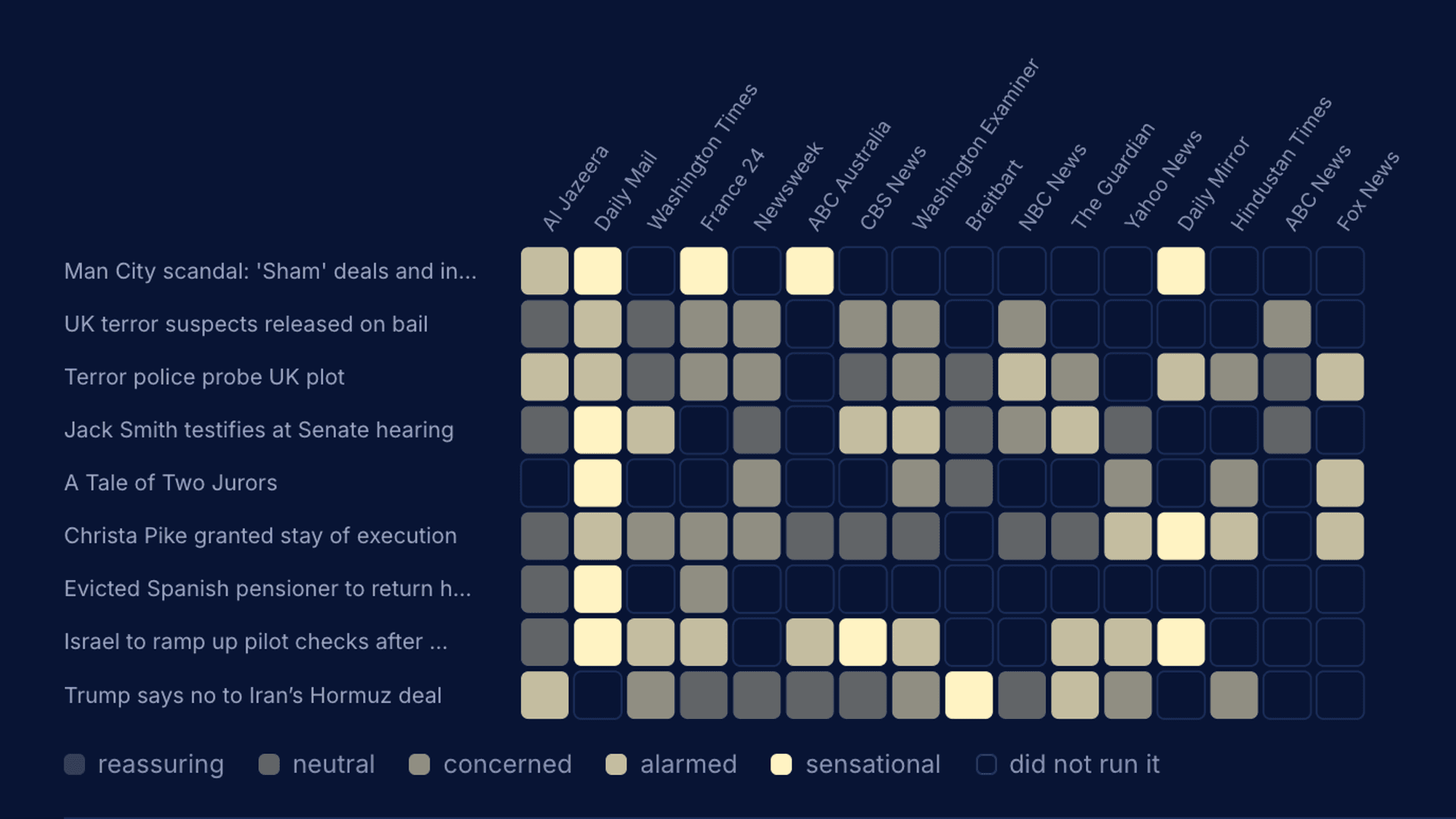
The result is Outliers, a small Belvedere Labs project that watches 88 news outlets for the stories they tell most differently. Jev reads each outlet's headline and teaser with the outlet's name removed and answers the same five questions, and the stories where the newsrooms disagree most rise to the top. The feed refreshes every few minutes.

What Jev Does With a Headline

Every headline and its teaser go to Jev with the same five questions.

  • How alarmed is the wording, from reassuring to sensational?
  • Does the headline state a fact, attribute a claim, ask a question, or offer an opinion?
  • Who, if anyone, does it hold responsible?
  • Does it promise more than its teaser delivers?
  • Is the language loaded?

Because Jev answers with probabilities rather than prose, the rest is simple math. We add up how far apart the outlets sit on each question, give every story a divergence score, and post anything over 30. The grid at the top of this page shows the tone answers, one row per story and one column per outlet, and a brighter square is a more alarmed headline.