
All Articles
Scott Fincher

Scott Fincher

Technical Growth Lead

Newsletter

Get a hard data challenge broken down every week.

No spam. Unsubscribe anytime.


3 articles by Scott Fincher

Did Prediction Markets See the 2026 Results Coming?

Did Prediction Markets See the 2026 Results Coming?

Scott FincherScott Fincher3 min readCase StudiesPublished November 5, 2026

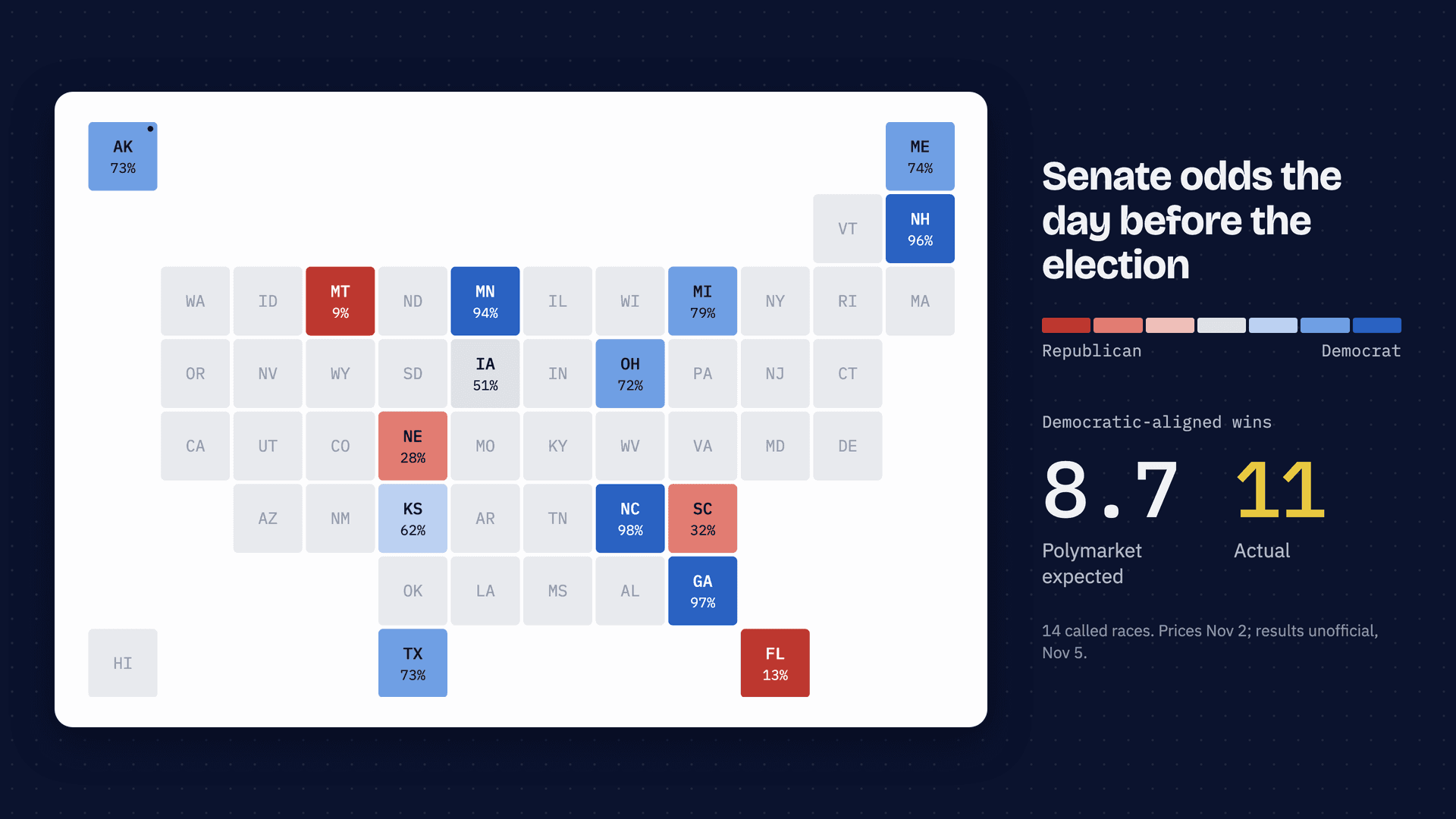
Prediction markets are the newest tool in election forecasting. More than $21 million was traded on Polymarket's Texas Senate market alone. A contract pays $1 if its candidate wins and nothing otherwise, so a 74-cent price means about a 74% chance.

In theory, traders with money on the line pay closer attention than anyone. The 2026 midterms let us test that by checking daily Polymarket prices and poll averages against the results. To dig into the data yourself, explore the Senate and governors' races in the Midterm Forecast Ledger.

We should say up front that we aren't political scientists or statisticians, just interested observers who like data.

What we found

Polls missed, and mostly in one direction. In 30 Senate and governor races with a prediction market and at least five recent polls, the final poll average underestimated the Democratic candidate in 25. On average, Democratic candidates ran about 3.5 points ahead of their polls.

That gap shrank as Election Day approached but never closed. It was almost 6 points 90 days out, 5 a month out, about 4 a week out and 3.5 the day before. Prediction markets drifted at about the same pace. Across all 67 resolved Senate and governor markets on Polymarket, prices implied about 35 Democratic-aligned wins 90 days out and 39 the day before. The actual number was 42.

How Good Are the New AI Weather Models? We Checked a Summer of Forecasts

Scott FincherScott Fincher5 min readCase StudiesPublished October 20, 2026

At Belvedere Labs we spend a lot of time trying out new AI capabilities, wherever they show up. Weather caught our eye because it makes an unusually clean test. The forecasts are public, the answers arrive a few days later from official thermometers and rain gauges, and two of the world's biggest forecasting agencies now run an AI model alongside their traditional one.

So we gathered the forecasts four models made for eight US cities from July to October 2026 and compared each one with what actually happened. This article is a short summary of what we noticed. The full data set lives in our interactive forecast explorer, where you can dig into any city, day or model.

Two Ways to Predict the Weather

Traditional forecasts come from physics. The model splits the atmosphere into millions of 3D boxes and applies the equations for air movement, heat and moisture, stepping forward a few minutes at a time until it reaches next week. That takes a supercomputer. We looked at the two best-known examples: IFS from the European centre ECMWF, and GFS from the US agency NOAA.

AI models take a different route. They are neural networks trained on decades of past weather, and they learn how the atmosphere tends to change over six hours. Repeating that step gets them a week or more ahead. Training one takes a lot of computing, but running it is far cheaper than running a physics model. ECMWF estimates its AI model uses about 1,000 times less energy per forecast, and Google DeepMind reported that its GraphCast model produces a 10-day forecast in under a minute on a single machine. The AI models still start from today's weather as measured and prepared by the traditional systems, so the two approaches work together. ECMWF made its AI model, AIFS, operational in early 2025, and NOAA followed later that year with AIGFS, which builds on GraphCast.

Introducing Investigate, Belvedere's New Data Analysis Agent

Introducing Investigate, Belvedere's New Data Analysis Agent

Scott FincherScott Fincher4 min readProductPublished September 15, 2026

A Common Engineering Problem

Maybe you’ve been there: you find yourself given access to a giant, half-documented store of data, and you’re not entirely sure what you even have. Even worse, maybe you’ve never seen most of it before! Your unfortunate task is to find the needle in the haystack on a tight deadline. Connections are fragile, and you can’t risk altering any of the data, but you need answers fast. Where do you begin, and what can you realistically hope to achieve?

A tough situation to be sure, but one that is fairly common. Here at Clear Fracture we found ourselves running into this too. That’s why we developed Investigate, a new feature available in Belvedere. Investigate is a read-only research agent that answers questions about your data, grounded in your catalog.

How Investigate Can Help

To start digging into a task like this one, normally you at least need to have an idea of what databases and tables might be available, along with their schemas. Lineage is likely to play a role too, so that you can understand both upstream and downstream data flows around a particular asset.

With Investigate, you have the luxury of letting an agent figure those things out and document them for you. Instead of starting with SQL queries, you start with plain English: