TypeSafe released Jev this month, and it is a different kind of model. Where a language model writes you a paragraph, Jev takes a typed question and hands back a probability for each answer. We wanted to explore the technology, so we gave it a fun job: reading the news.
The result is Outliers, a small Belvedere Labs project that watches 88 news outlets for the stories they tell most differently. Jev reads each outlet's headline and teaser with the outlet's name removed and answers the same five questions, and the stories where the newsrooms disagree most rise to the top. The feed refreshes every few minutes.
What Jev Does With a Headline
Every headline and its teaser go to Jev with the same five questions.
- How alarmed is the wording, from reassuring to sensational?
- Does the headline state a fact, attribute a claim, ask a question, or offer an opinion?
- Who, if anyone, does it hold responsible?
- Does it promise more than its teaser delivers?
- Is the language loaded?
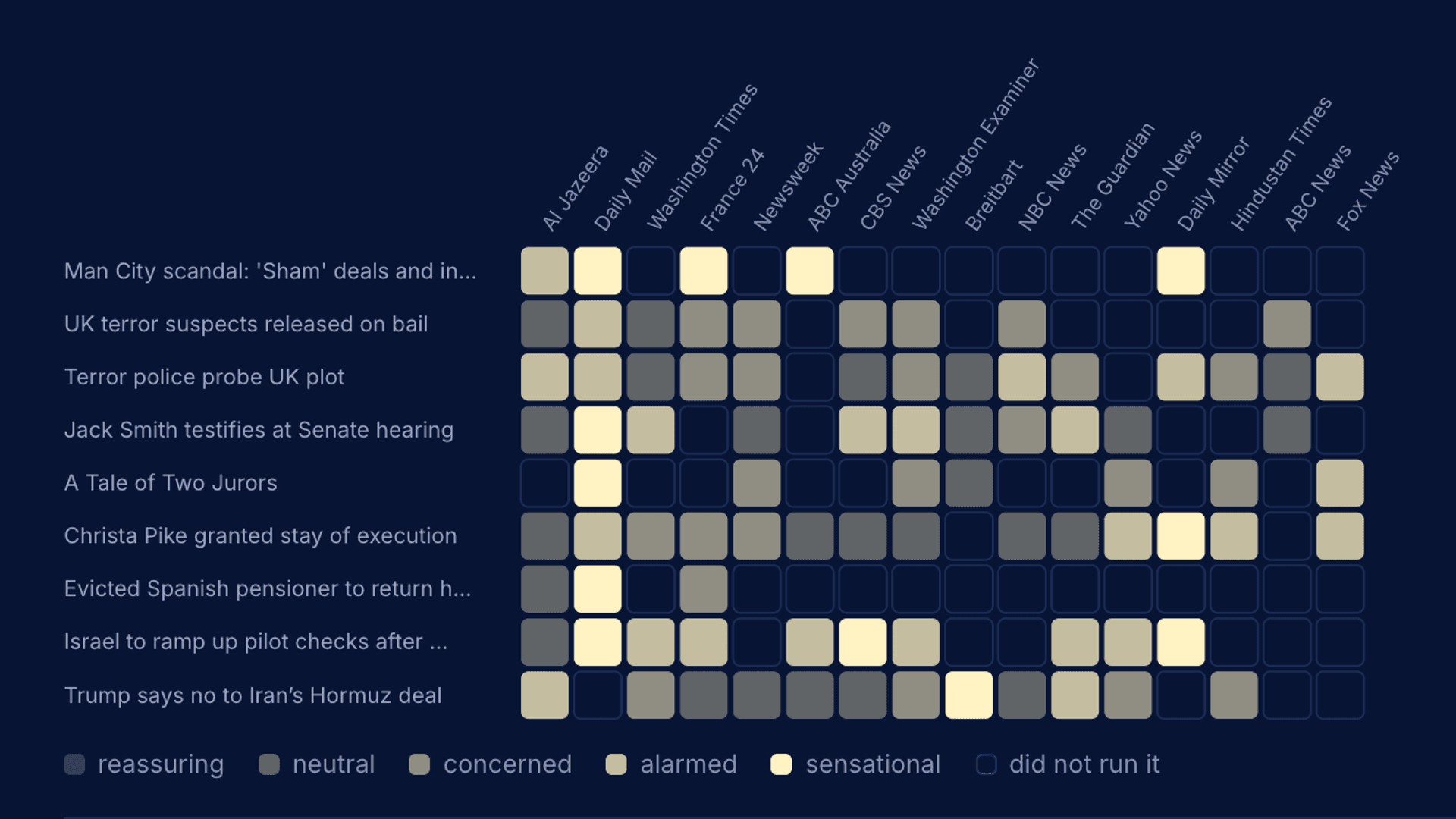
Because Jev answers with probabilities rather than prose, the rest is simple math. We add up how far apart the outlets sit on each question, give every story a divergence score, and post anything over 30. The grid at the top of this page shows the tone answers, one row per story and one column per outlet, and a brighter square is a more alarmed headline.
One Story, Eight Outlets
Last week an 87-year-old woman was carried out of the Madrid flat she had lived in for 70 years, and this week, after protests across Spain, the property firm backed down. Eight outlets covered the reversal. BBC News ran "Evicted Spanish pensioner can move back home, lawyer says," which Jev read as neutral. The Daily Mail ran "Spanish pensioner, 87, is allowed to return home after she was evicted by riot cops after investment brothers pushed her rent up by 275%, sparking nationwide fury," which it read as sensational. The same outcome, told two ways.
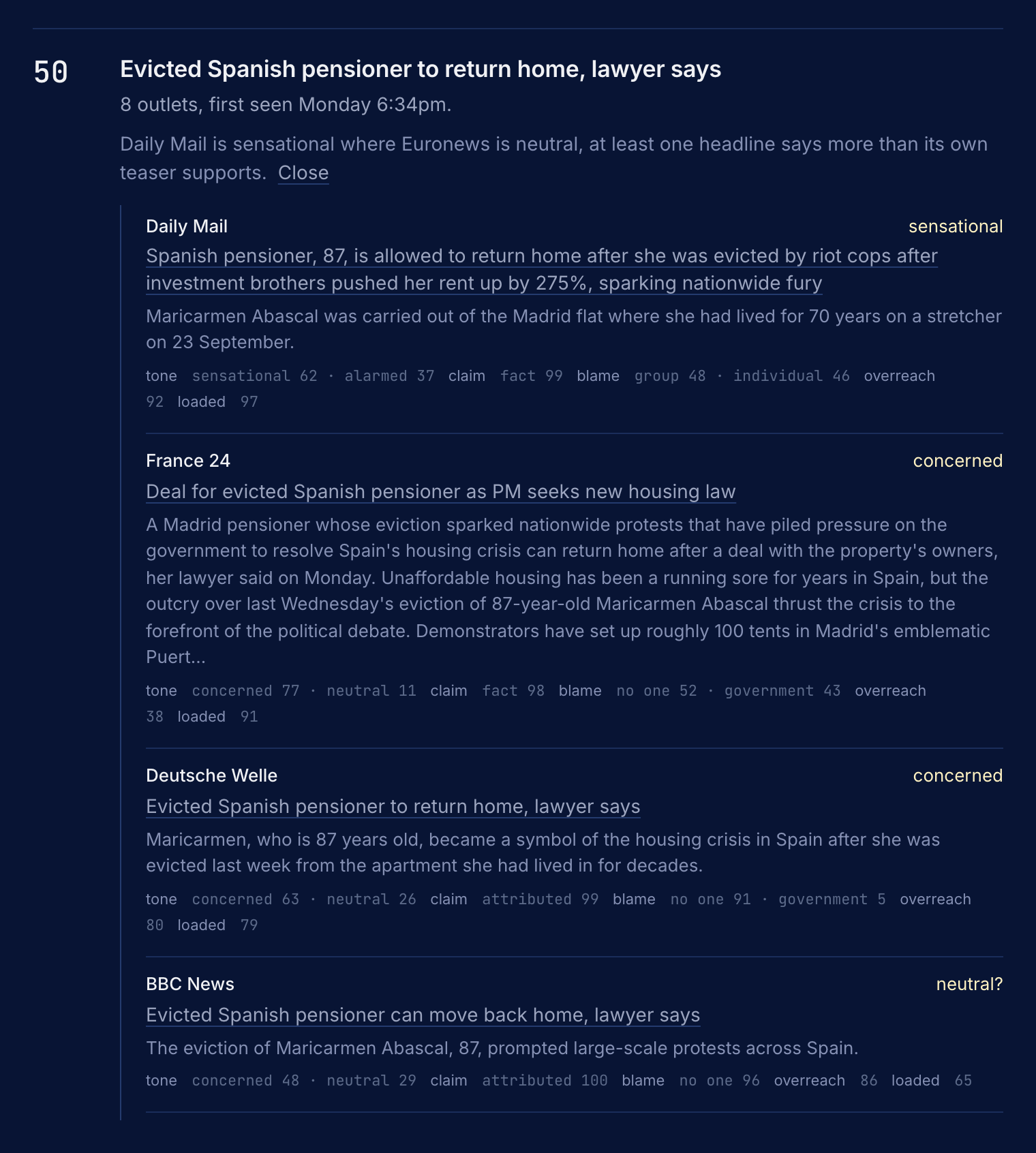
Four of the eight outlets, from most to least alarmed. Each row shows the outlet's headline and teaser as published, with Jev's probabilities in grey. A question mark marks a tone Jev wasn't sure about. Scoring the story took eight calls and about two hundredths of a cent.
Why It Was Worth Trying
The economics make it practical. One call takes around 330 milliseconds and costs about three thousandths of a cent, so a day of headlines, roughly 1,600 of them, comes to five cents.
Belvedere Labs is where we try new technology and put out small open tools for data and software engineering, like the SysML Repo Modeler and Flue Analyst.
See It Live
The feed is at belvederelabs.ai/outliers. Open any story to see how each outlet answered and what it cost to score. Machines can read the same feed as JSON or llms.txt.
To see how Belvedere puts agents to work on your own data, book a demo.